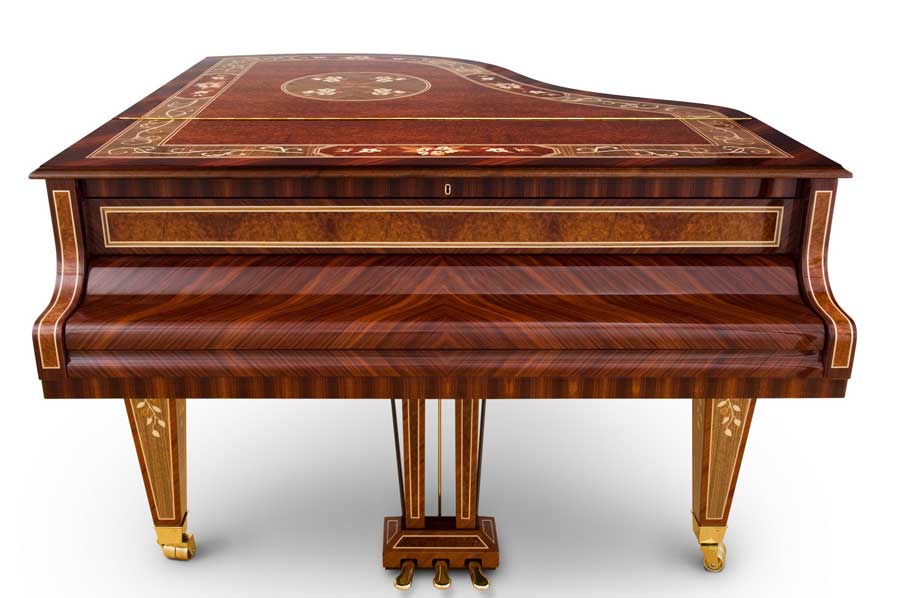
Another harpsichord to a happy home
Outside Promotion
Moving Sucks…mostly
There have been a lot of projects in my life lately, the biggest and most all-consuming has been my move to new workshop/office space.
When I moved into the old space about 2 years ago, I knew it would be temporary and the true requirements would evolve as business developed. For that reason I didn’t do much, let’s say, decorating. The result was functional and efficient but hardly attractive.
I’m in the BTTC, the Bridgeport Trade and Technology Building, a huge complex of industrial buildings now turned into a “business incubator”. My neighbors include aspirin manufacturers, artists, a guitar maker, a number of woodworking shops, and the leading maker of energy drink components. It is a strange and eclectic mix into which I fit perfectly.
Bridgeport is a tough town, a major manufacturing center that has still not recovered from the decline of US manufacturing in the 80′s. So, the scenery is different, but the rent is cheap.
I’m staying in BTTC but needed space that was both larger and more suited to visits by prospects and customers. A soy candle maker moved out and I started the project that has completely dominated my March.
This photo is pretty early in the process, after the floors were scrubbed and painted, the walls painted and the shelves started. Nobody is going to consider this a high end showroom, but it will serve my purposes well and has great views, sun and vibe. In the back you can see the separate room that will allow me to show product and entertain visitors in a less shop like setting. Also notice that the space has water, allowing me to keep the humidifiers filled in the winter with less headache and backache.
It has been a long and exhausting process but is finally (mostly) done. Onward and upward.
What’s In A Name?
There has been a lot of change at FEURICH lately which has led to some confusion. I will attempt to describe the current lay of the land, AS I UNDERSTAND IT. I have been very close to the main players over the past 2 1/2 years and I believe that I have a pretty clear understanding of what has been happening. But, these are MY OPINIONS. Others, of course, have the right to suggest corrections or different points of view.
Traditional and Modern Soundboards
The soundboard is one of the most important parts of a piano. Soundboards have traditionally been made of thin planks of solid spruce, about 1/2 inch thick and the width of your hand, glued together on the edges to form a very large surface. While this traditional approach has been used throughout the history of the industry, there are some very well known problems with this approach.
You Must Have a Good Ear…
I’ve been told that I must have a good ear, usually by someone I’ve just met who has learned that I’m a piano technician, and I’ve always wondered exactly what it meant.
Piano tuners do train themselves to hear components of piano tone, usually called partials or harmonics. These are pitches within pitches (the g that sounds 1 1/2 octaves above midde C on the piano for example) and they are an important part of what the tuner listens to when tuning. However the process of learning to tune was not easy. In fact it was quite agonizing and long and there are still times when I think the piano is going to win.
I think I now know that “having a good ear” means being able to detect very subtle differences in sound or musical tone and, secondarily, having the skill to adjust those tonal differences, either with a tuning hammer or a voicing tool.
RPT Repeat
I finally did it. I passed the final technical tests to regain my RPT (Registered Piano Technician) status with the Piano Technicians Guild. If you haven’t been following my progress (what?? you haven’t??) go to this post for a refresher.
The whole process was indeed an ordeal. While the bench tests were pretty much the same, the time requirements have been tightened up which adds a level of stress. While you very rarely have those kinds of time restrictions when actually in the field doing repairs, it does mean you have to have a certain level of facility with the repairs…it has to be more than “book learning”. The time stress caused a couple of dumb mistakes on my part but the grading also allows for that, so even though my flange bushing cloth pushed out of one side when I was easing it, I still passed.
Trust me, I am not allowing my PTG membership to lapse again.
My Evolution as a Webmaster
I’ve had good teachers.
I’ve always had a sense that no matter what I was involved in, there was always somebody better at it and something I didn’t know. In some activities you have to know when to balance this with the simple enjoyment of the activity, like piano playing.
In other activities, like piano work, I’ve always felt like somebody better was standing right there, watching me, waiting to evaluate my work when I was done. This can be, of course, somewhat unnerving but I found it always pushed me to raise my standards, to be better and my skill level and clients have benefited.
I’ve been managing and developing website for a long time now, at least 10 years. I have always been interested in the information organization and dissemination aspects rather than the design aspects. I’m no designer and I’m really not a coder so I always sought out tools that would allow me to concentrate on the information rather than the raw html, css or sql coding. Even so, I slowly developed my ability to deal with robots.txt, htaccess files, php scripts and sql databases.
The Myth of Artist Endorsements
It is common for piano manufacturers to tout a list of artists with whom they enjoy some sort of connection. Sometimes that connection is rather tenuous since that artist may have affiliations with more than one company and, frequently, they have been dead for a number of years.
However, artist endorsements form a sort of seal of approval for wary piano purchasers who don’t necessarily trust their own ears. Often buying a piano with artist endorsements is an easy way to demonstrate ones own cultural sophistication, even when one knows and cares little about the piano. But, are lists of artist endorsements truly a gauge of the quality of a piano and its appropriateness for you?
To use an clever example by someone in the business, think about the Lincoln Town Car. If you call for a car service in New York City, most likely you will be picked up in a Lincoln Town Car. Since many professional drivers in NYC use the Lincoln Town Car, does that mean that it is the best car for everybody?
Artist endorsements are rarely free. The artist is looking for something as is the manufacturer, otherwise why do it? The maker is looking for big names who allow the maker to freely use their identity in their advertising. The artist is looking for access to pianos, for home, concerts and recordings. The artist usually hopes to get this for free, but that is rarely the case.
What follows is kind of long and twisted, but it comes from deep personal experience. If you really want to understand the world of concert pianos, at least in the US, you may want to struggle through.